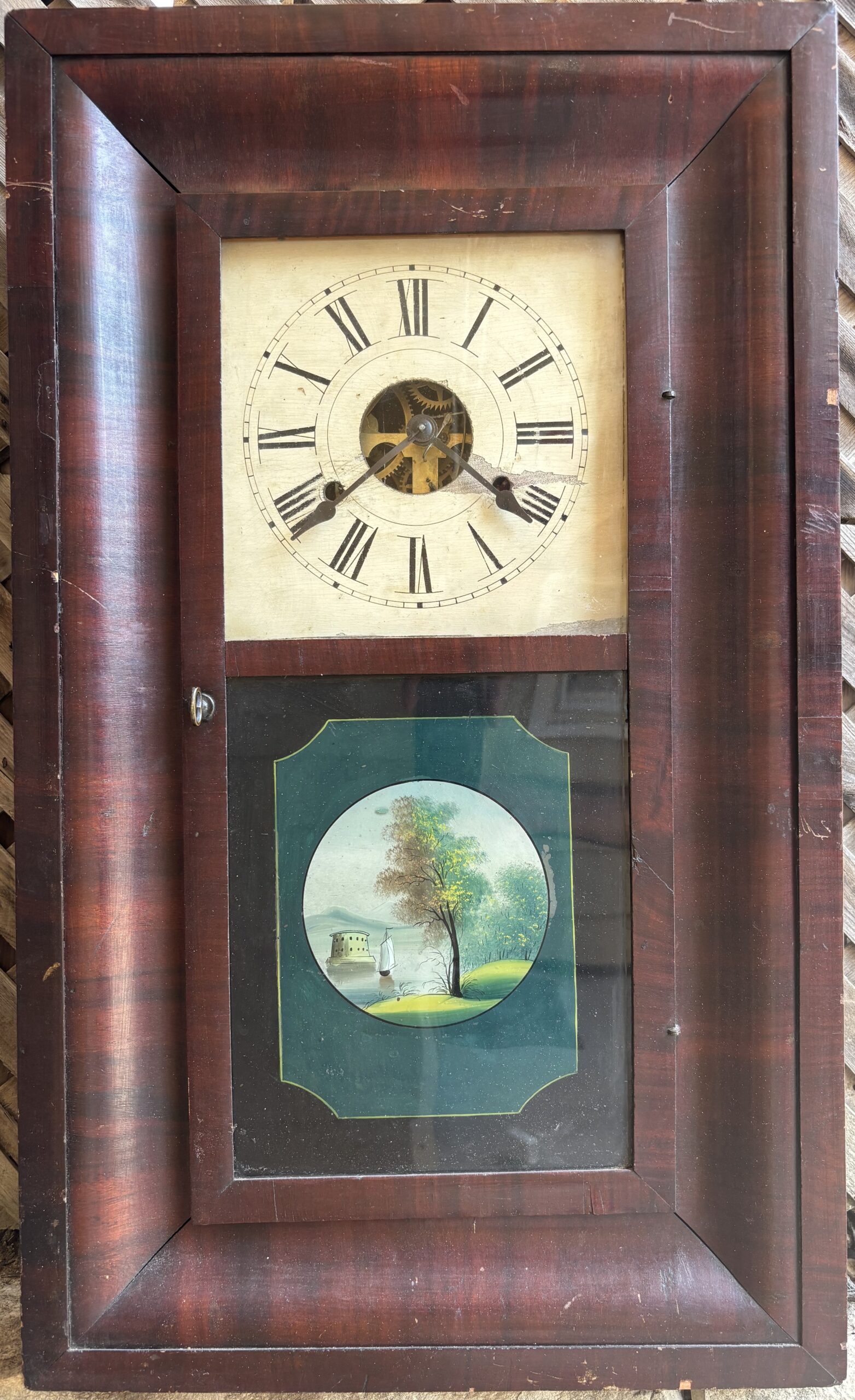
 This is the second clock I’ve come across that I believe to be a counterfeit Jerome. The first one can be found here. Without repeating all of the background associated with these counterfeit clocks, I’ll summarize by saying that Chauncey Jerome sued two firms, Samuels & Dunn and Sperry & Shaw, for selling their own clocks under Chauncey Jerome labels in Europe. Sperry & Shaw have a fairly well-established record as clock makers in New York City from c. 1844-1851. The record for Samuels & Dunn, on the other hand, is essentially nonexistent, other than Jerome’s mention of them in his autobiography. Spittlers & Bailey have the following skimpy listing for the company:
New York, N.Y. Ca. 1844. Supposedly sold OG clocks with Jerome’s labels, sued by Jerome.
The listing appears to be based primarily on Jerome’s autobiography, though Jerome does not assign an explicit date to them. I found one reference to a Samuels & Dunn clock in the June 14, 1946, New York Sun. It was in a Question & Answer column containing the following exchange:
R. G. H., New York, asks the age of a mahogany shelf clock that is marked “Samuels & Dunn, New York.”
Samuels & Dunn sold clocks in New York city in 1844 but were not clockmakers. It is said they used spurious labels with names of reputable clockmakers who made good clocks but not those sold by this firm. In other words, Mr. Samuels and Mr. Dunn, who had a shop over 100 years ago would be considered clock bottleggers (sic) today.
Unfortunately, the column in the Sun is not clear whether “Samuels & Dunn” is on the label, the movement, or both. I looked through Snowden Taylor’s updated file of 30-hr movements and found no listings for Samuels & Dunn. I did, however, find a number of listings for Wilson & Dunn, who Spittlers & Bailey document at 18 Courtlandt St in New York, based on a known OG from c. 1844. Is this the same Dunn as Samuels & Dunn? Unknown. My reason for trying to learn more about Samuels & Dunn is that the label in my latest counterfeit Jerome is quite different from the one in my other counterfeit, which I attributed to Sperry & Shaw. And, whereas the other counterfeit label was printed by Wells, Brownson & Co., the label in this clock has no printer’s line. My initial reaction was that this could be one of the ogees by the elusive Samuels & Dunn.
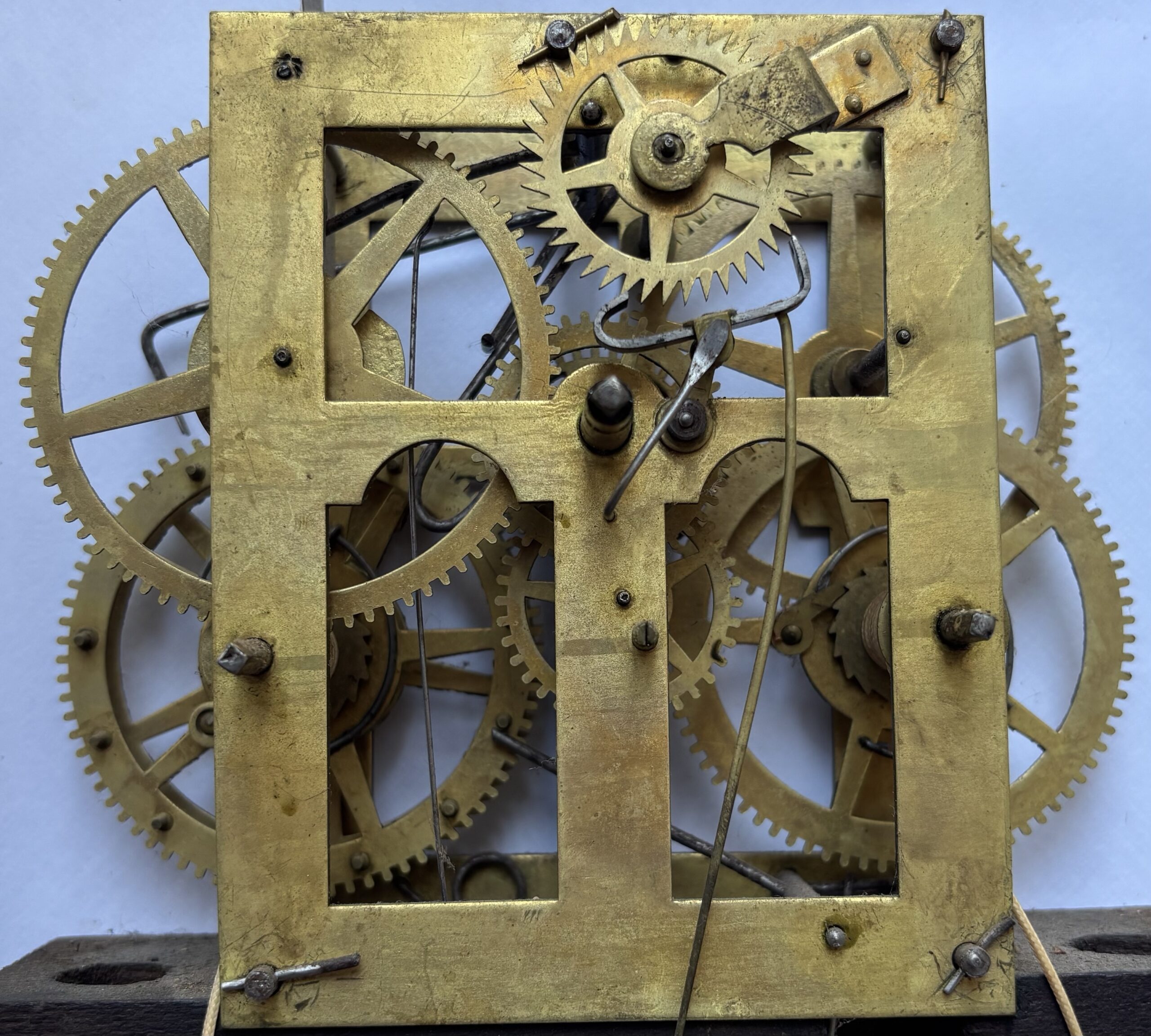 The movement is a type 6.43 (Snowden’s updated ID #; original # 5.43), made by the Union Manufacturing Co. (in business c. 1843-1845, according to Spittlers & Bailey). Sperry & Shaw is an identified user of this movement, though the company purchased movements from as many as 16 different firms. I’d like to suggest that this doesn’t rule out Samuels & Dunn as the “maker” of this counterfeit. There’s no evidence to suggest Samuels & Dunn made movements, so they would have purchased movements from Connecticut makers, as did Sperry & Shaw.
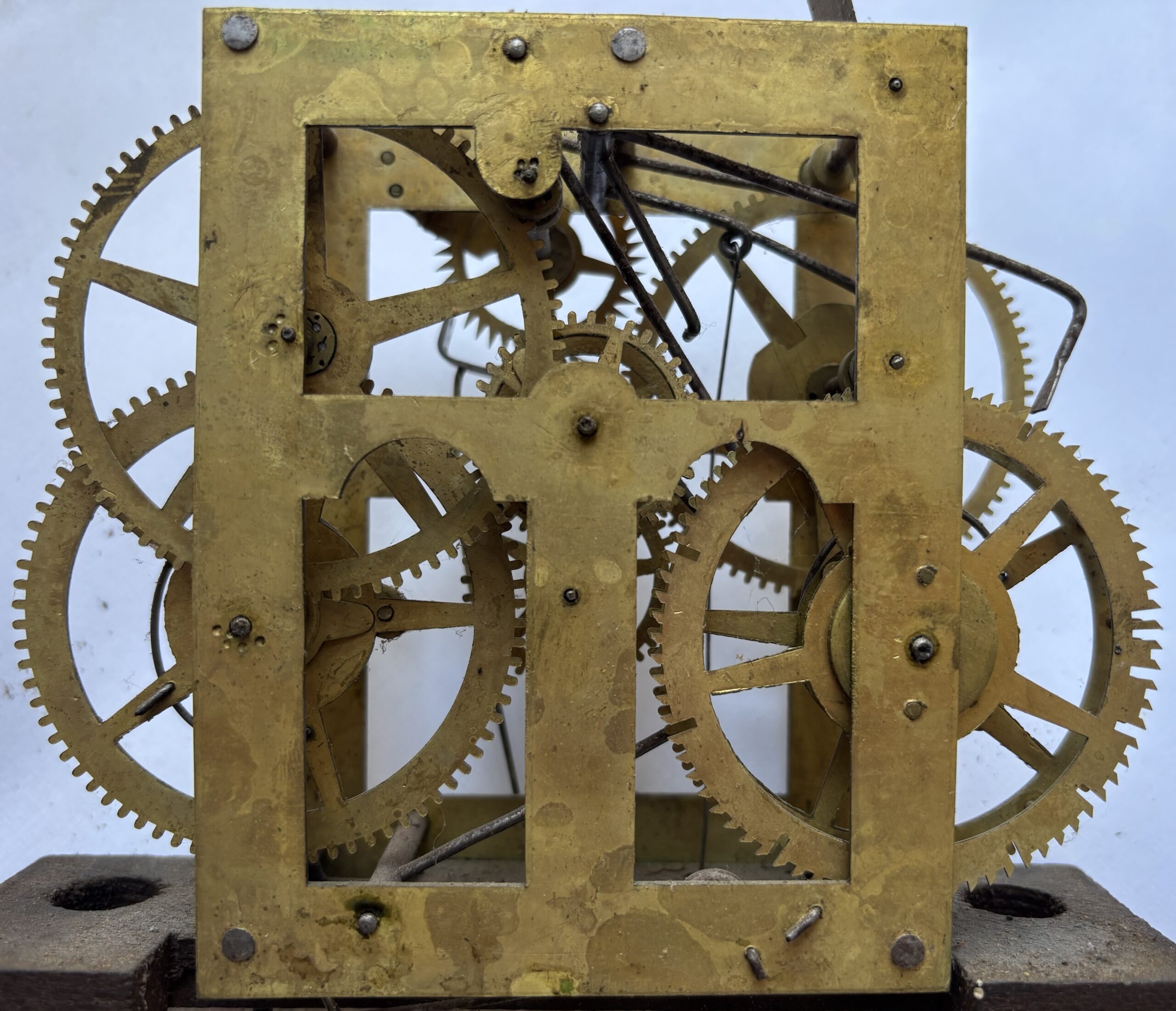 Rear view of type 6.43 movement.
Although this clock was purchased from a seller in the US, I’m inclined to believe that it spent a fair amount of time in the UK. The top board of the case is riddled with worm holes. Knock on wood (pun intended!), I don’t see evidence of current woodworm activity.
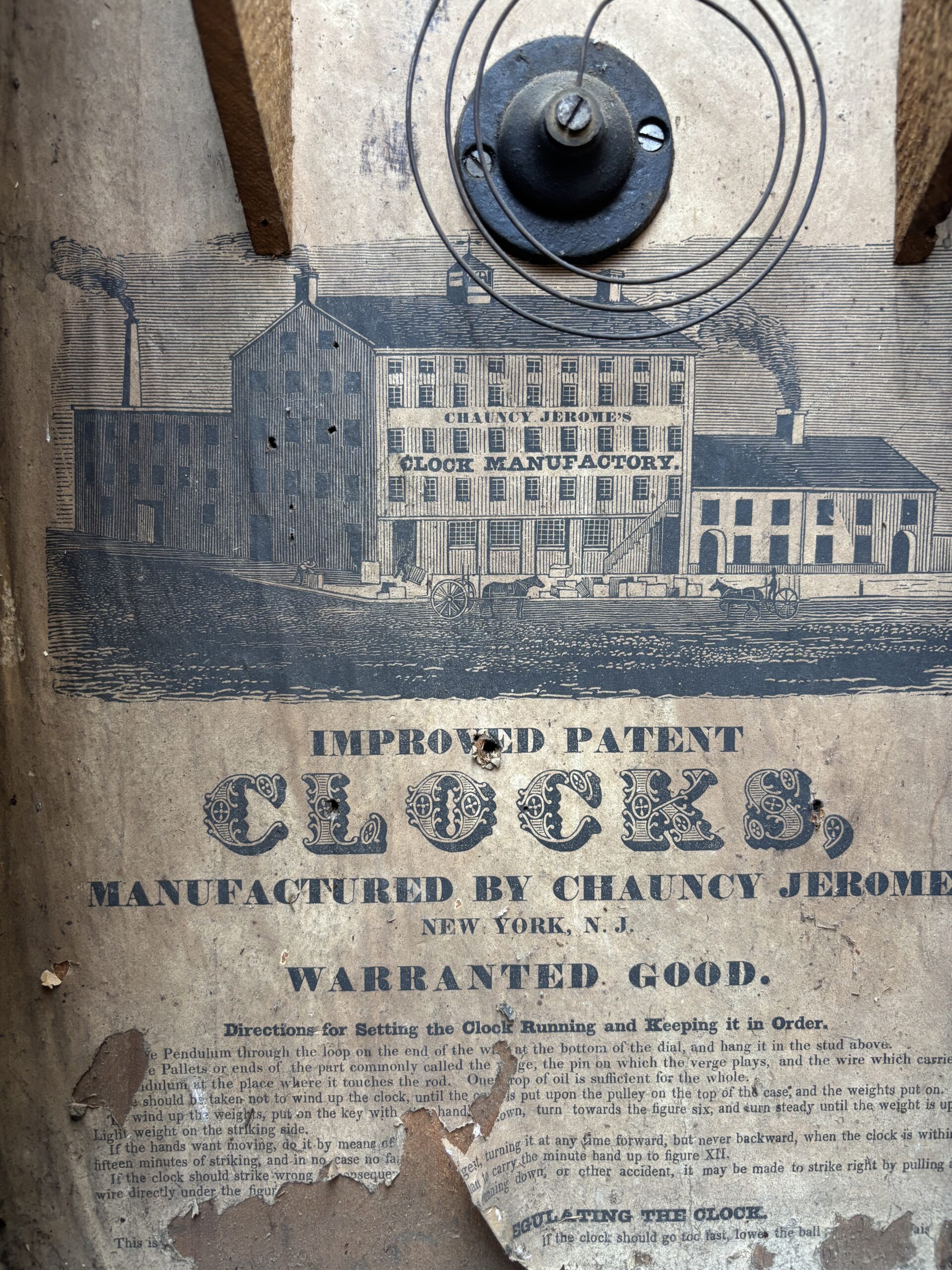 The label has a few interesting characteristics. The first is simply the depiction of a clock factory on it. That motif may pilfer from Jerome’s practice of using an image of his New Haven factory on labels, starting perhaps as early as the mid-1840s. However, the factory on the counterfeit label is not Jerome’s New Haven factory. Another feature of the label is the misspelling of Jerome’s first name, “Chauncy”, rather than Chauncey. Name spelling could be a bit loose in the 19thcentury, so this isn’t an egregious deviation. Perhaps the most interesting feature is Jerome’s business address of “New York, N. J.” As everyone knows, the city of New York is not located in New Jersey. Was this simply an innocent typo (J in place of Y) or something else?
Snowden Taylor’s correspondence with me reveals one other example of a clock with this label. The movement in that clock he identified as a type 2.(10)23, but I’m unclear on whether that was old or new numbering. Regardless, Sperry & Shaw are not identified as users of the 2.(10)23 movement. That leads me back to wondering if the label might be associated with Samuels & Dunn.
And this is where my search for answers flames out. I looked through every New York City directory from 1840 to 1853 and found no Samuel or Samuels listed with any connection to the clock industry. Note that the name “Samuels” in Samuels & Dunn could refer to a person by the name of Samuels or two or more by the name Samuel. The directories were far more revealing with respect to Mr. Dunn. From 1842 to 1851 (except for 1848 and 1849), there is a Robert Dunn whose occupation is variously given as “clockmanuf.” or “clockcasemaker”. After 1851, Robert Dunn, the clock maker, drops out of the directories. For nearly all of these years, Dunn shared a business address with Solomon B. Wilson. The discrepancies in addresses, in some cases, are the result of incomplete addresses; in others, the discrepancies could be typos (272 vs. 274 Fifth St., for example). Adding to the confusion, there is no Solomon Wilson in the 1850 directory (he reappears in 1851); instead, there is a clock case maker by the name of Samuel B. Wilson. The middle initial and occupation convince me that Samuel is likely an error. Unfortunately, his home address is simply “Fourth” street, with no house number. Previously, his home address was given as 554 Fourth St. For 1842, 1843, 1845, and 1846, there are separate listings for the company, Wilson & Dunn, purveyors of clocks & looking-glasses or later simply clocks. Despite an apparent connection between Wilson and Dunn after 1846, there are no further listings for Wilson & Dunn. The last piece of information regarding the name “Dunn” is that none of the other Dunns listed in the city directories have any connection to the clock industry. If a Dunn was in partnership with a Samuels, the only candidate is apparently Robert Dunn; the same Robert Dunn who was partnered with Solomon Wilson for the period in question.
How then to account for the Samuels & Dunn clock mentioned in the 1946 NY Sun? One explanation for the absence of any trace of Samuels & Dunn in the city directories is that the partnership lasted less than a year. They were not in business when the information was being compiled annually for the city directories. However, it’s inconceivable to me that a partnership between Samuels and Dunn could have lasted for less than a year and yet was able to develop a market in England selling counterfeit Jerome clocks for long enough that it caught the attention of Chauncey Jerome, and then were successfully sued in court by Chauncey Jerome. That’s an awful lot to happen in a year!
Were it not for the question in the 1946 NY Sun, I would say there’s a strong case for suspecting that Samuels & Dunn existed solely for the purpose of selling counterfeit Jeromes overseas. If so, then the partner, Samuels, may not have even existed. This is supported by the total absence of a Samuels associated with the clock industry in the city directories. However, the existence in 1946 of a clock marked “Samuels & Dunn” suggests the company was legit. Is the “Samuels” in Samuels & Dunn somehow tied to the peculiar 1850 directory listing for Samuel Wilson? All of this leaves me with no satisfactory explanation for the truth behind the elusive Samuels & Dunn.
As for the clock that prompted this post, I have no doubt that it was fraudulently marketed overseas as a Chauncey Jerome clock by a New York firm, possibly Samuels & Dunn or Sperry & Shaw.